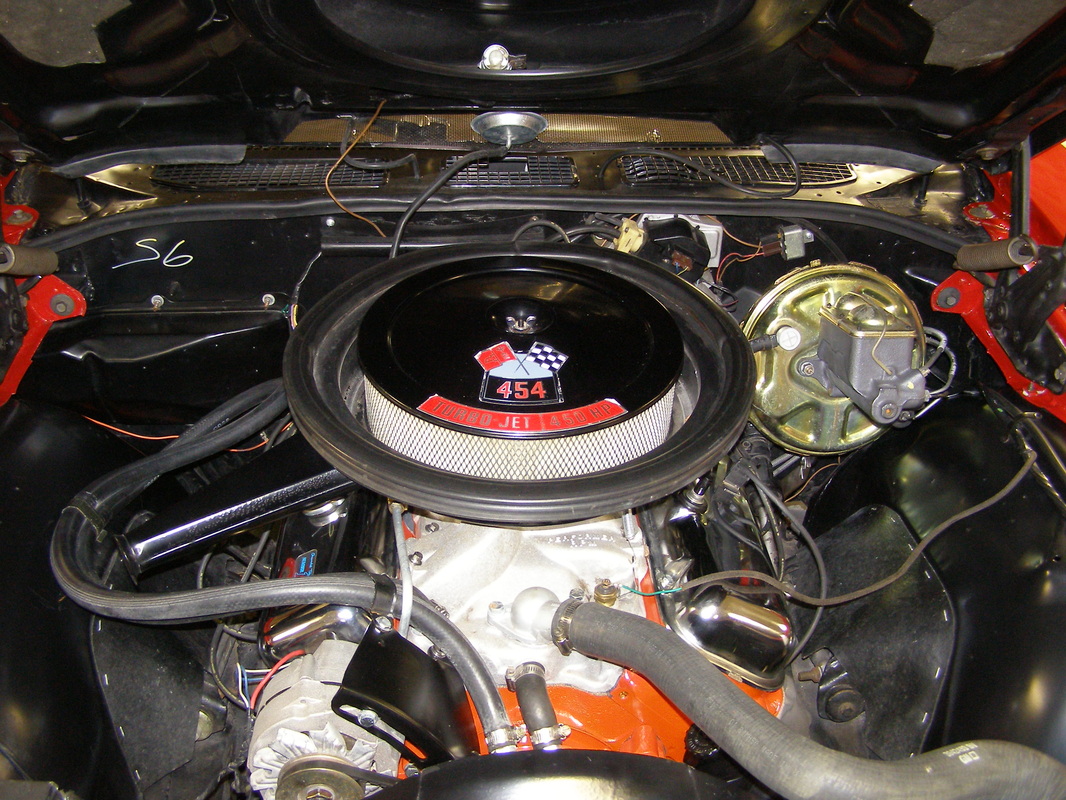
When we last left our intrepid Chevelle it was motoring merrily along the highway. On one afternoon drive it started overheating and got progressively worse. When it started missing and resembling a steam calliope playing Bach’s Toccata in Fugue (that means it was really hot!) he pulled into a gas station and let it cool down. The mechanic on duty tested for combustion gasses in the cooling system and verified that something was blown. It got towed back to my shop.
After running a compression check and verifying 2 bad cylinders I pulled off the left head and, sure enough, it had a blown head gasket between #5 and #7 (the rear two) and was starting to blow between #3 and #5. Closer inspection revealed that #7 (which is the one that had been sleeved during an earlier overhaul) had partially collapsed and was impinging on the crown of the piston at TDC. The engine had to come out and get torn down completely.
To cut to the chase; the pins that had been installed along the crack between the Time-Serted head bolt and the sleeve in #7 were the perpetrators. The pins started by overlapping into the Time-Sert and ended by overlapping into the outer edge of the sleeve. The torque from the head bolt deformed the Time-Sert along the path of least resistance (the pins) and forced the last pin to push in on the sleeve, effectively wiping out the.010”-.015” clearance at the crown of the piston. Pushing on the sleeve also opened up a direct path into the water jacket. The heat from the tight piston created a hot spot in the gasket, which disintegrated, allowing the coolant to become superheated by the combustion gasses. And so on and so on… If the last pin had ended a ¼“ before the sleeve it probably wouldn’t have happened. Since the original crack went all the way to the sleeve the last pin had to go into the sleeve.
It was time to say goodbye, adios, sayonara, aloha, auf wiedersehen, au revoir, arrivederci, nice knowin’ ya and buh-bye to the block. PER acknowledged that they should have just said, “No way, Jose¢” to the block repairs, but nonetheless said they’d credit the cost of all the block repairs towards a replacement block and graciously volunteered to give me cost on non-warranty new parts and required labor to rebuild the next engine. The heads, crank, rods, cam and chain could all be used again, but new pistons, rings and bearings would have to be part of the rebuild program.
To bring this little tale to closure: On “Craig’s List” I found a solid “correct numbers” block for $2000 (believe it or not, that’s a fair price these days), all the machining was done, it was assembled, I installed it, it ran perfectly, it goes down the road very quickly.
One of the reasons used parts fail is due to a phenomenon called “duty cycle” (and it has nothing to do with firewatch schedules at a swap meet). Duty cycle refers to how many oscillations, vibrations, flexings, twists, up-and-downs, compressions and stretches any given part can go through before its molecular structure (material) starts to degrade or break down. I read once that leaf springs are good for a million oscillations. That sounds like a lot until you consider that every bump and dip in a road, no matter how small, is an oscillation or two. And while a spring is a very visual example, axles are harder to imagine. Rear axles not only support the load of the vehicle but also put up with twisting...both directions. The fronts are not only subjected to supporting the vehicle but also side loading from turning, and in the case of front wheel drive they’re also twisted. While a spring may show its fatigue in an obvious fashion (sagging), an axle will rarely show that it’s ready to fail. Usually their failures will start internally and to detect that properly they must be x-rayed. Having new rear axles made is not terribly expensive ($250-500 each), and can save a lot of grief.
I’ve had a couple of embarrassing axle failures. One was in my first car, a 1952 Willys Aero-Eagle. I was leaving a friend’s house and I gunned it a little (okay, a lot) to make an impressive getaway. There was a loud “BANG!”, the rear end of the car hopped up in the air a couple of feet and came crashing down, all askew. I looked out the passenger window and saw the right rear tire, brake drum and 2 inches of axle stub come rolling by as a unit and ultimately flop over against the curb 20 feet in front of me. Further inspection revealed that the axle had crystallized. This was in 1963, so the car was only 11 years old! What could cause it? Bad steel, bad tempering? You see, at my friend’s house I took it upon myself to perform a durability test and found it’s limits falling short of what I expected. But I still say it was a weak axle. That’s my story and I’m sticking to it!.
The second failure involved my 1927 Franklin. This was the last year Franklin used a contracting band around a drum at the end of the transmission for the service brake. It was a horrible system even when perfect. One of the major design problems was that if a rear axle failed there would be no brakes because of the loss of the differential action in the rear end. A Franklin axle tapers down greatly just before the spider gear splines, making it a real weak spot. Don’t ask me how I know and how fortunate I am to still be here.
I found a new axle for the Willys and was able to flog it unmercifully for the rest of my sophomore year. The Franklin, however, had to settle for a replacement used axle, and I was leery (read very cautious) for the next 6 years until I sold it.
I believe that parts which have a high duty-cycle rate or are old and involve safety or reliability should be replaced…even when a non-stock replacement is the only option. We’re talking leaving you stranded on the side of the road at the very least, or risking yours and others’ lives, and ruining a perfectly good vehicle just for the sake of keeping something “original”.
One good example is ignition condensers. Never use an old one (NOS) when a new equivalent is available. Sure, I’ve had new ones fail right out of the box, although it’s very rare. A condenser is basically a thin sheet of tin foil rolled up with a layer of special thin paper or, in the earlier ones, wax paper sandwiched between the layers of tin. They can be very hardy, but It doesn’t take much for them to go bad. There isn’t a condenser for an old clunker that can’t be replaced with a brand new one. It might look different but there’s only a limited range of capacities required to make a system work and all are easily adaptable. Most condensers are hidden from view anyway. Why put your trust in some 60 year old part “with the correct date code” that can had brand new for $8?
One of my favorite stories (heard through the grapevine) is about a 1915, or so, Hudson that was completely refurbished and run in “The Great Race” back in the early 90s. About half way through the race it threw a rod and wiped out the block. The engine was built perfectly stock with nice original parts. The problem was that Hudsons of that era used tubular connecting rods which were notorious for coming apart. It wouldn’t have cost all that much to have a new set of contemporary, stronger rods made up….but, nooooo, this guy had to be a purist, even with a highly stressed part that no one would ever see. Well, he got his wish: He now has a perfect example of a pure stock Hudson engineering flaw to show his friends.
A friend has a 1932 Lincoln. The original, extremely rare, one year only carburetor was wheezed out. It wasn’t all that great a design when new and wasn’t worth rebuilding. Well, the car now sports a new, modern 2 barrel Holley and runs flawlessly. All it took was making a simple adapter. Nothing original was really changed or altered and it can be returned to poorly running stock form at any time. A purist would blanche, but my friend doesn’t care
It is my philosophy that it’s nice to have a few pure stock examples of all the various models of cars for posterity. It’s fine that they are in museums or are trailer queens. However, most of us mere mortals enjoy driving these old beaters and it’s just not practical or economically feasible to subject ourselves to inconvenient, safe, and other unnecessary failures. I’m not advocating turning them all into hot rods, but just to use some critical 70 year old part simply because it has the “original 3 dots and a triangle cast into it with the proper sequence of foundry numbers” (who really cares?). Not only is it not prudent, but it’s also one of the reasons this game we play is so expensive…however, that’s fodder for another article. The beauty is that so many things can be modernized without permanently altering the original car or disturbing its “essence”. In many cases the car will run better than new. That’s not a bad thing, is it?
The bottom line is: Know when to say goodbye. Take that old original part and put it on the wall. Start your own little museum of old, original parts. Put new replacement parts on your car whenever you can. Remember: “Safety First.”
After running a compression check and verifying 2 bad cylinders I pulled off the left head and, sure enough, it had a blown head gasket between #5 and #7 (the rear two) and was starting to blow between #3 and #5. Closer inspection revealed that #7 (which is the one that had been sleeved during an earlier overhaul) had partially collapsed and was impinging on the crown of the piston at TDC. The engine had to come out and get torn down completely.
To cut to the chase; the pins that had been installed along the crack between the Time-Serted head bolt and the sleeve in #7 were the perpetrators. The pins started by overlapping into the Time-Sert and ended by overlapping into the outer edge of the sleeve. The torque from the head bolt deformed the Time-Sert along the path of least resistance (the pins) and forced the last pin to push in on the sleeve, effectively wiping out the.010”-.015” clearance at the crown of the piston. Pushing on the sleeve also opened up a direct path into the water jacket. The heat from the tight piston created a hot spot in the gasket, which disintegrated, allowing the coolant to become superheated by the combustion gasses. And so on and so on… If the last pin had ended a ¼“ before the sleeve it probably wouldn’t have happened. Since the original crack went all the way to the sleeve the last pin had to go into the sleeve.
It was time to say goodbye, adios, sayonara, aloha, auf wiedersehen, au revoir, arrivederci, nice knowin’ ya and buh-bye to the block. PER acknowledged that they should have just said, “No way, Jose¢” to the block repairs, but nonetheless said they’d credit the cost of all the block repairs towards a replacement block and graciously volunteered to give me cost on non-warranty new parts and required labor to rebuild the next engine. The heads, crank, rods, cam and chain could all be used again, but new pistons, rings and bearings would have to be part of the rebuild program.
To bring this little tale to closure: On “Craig’s List” I found a solid “correct numbers” block for $2000 (believe it or not, that’s a fair price these days), all the machining was done, it was assembled, I installed it, it ran perfectly, it goes down the road very quickly.
One of the reasons used parts fail is due to a phenomenon called “duty cycle” (and it has nothing to do with firewatch schedules at a swap meet). Duty cycle refers to how many oscillations, vibrations, flexings, twists, up-and-downs, compressions and stretches any given part can go through before its molecular structure (material) starts to degrade or break down. I read once that leaf springs are good for a million oscillations. That sounds like a lot until you consider that every bump and dip in a road, no matter how small, is an oscillation or two. And while a spring is a very visual example, axles are harder to imagine. Rear axles not only support the load of the vehicle but also put up with twisting...both directions. The fronts are not only subjected to supporting the vehicle but also side loading from turning, and in the case of front wheel drive they’re also twisted. While a spring may show its fatigue in an obvious fashion (sagging), an axle will rarely show that it’s ready to fail. Usually their failures will start internally and to detect that properly they must be x-rayed. Having new rear axles made is not terribly expensive ($250-500 each), and can save a lot of grief.
I’ve had a couple of embarrassing axle failures. One was in my first car, a 1952 Willys Aero-Eagle. I was leaving a friend’s house and I gunned it a little (okay, a lot) to make an impressive getaway. There was a loud “BANG!”, the rear end of the car hopped up in the air a couple of feet and came crashing down, all askew. I looked out the passenger window and saw the right rear tire, brake drum and 2 inches of axle stub come rolling by as a unit and ultimately flop over against the curb 20 feet in front of me. Further inspection revealed that the axle had crystallized. This was in 1963, so the car was only 11 years old! What could cause it? Bad steel, bad tempering? You see, at my friend’s house I took it upon myself to perform a durability test and found it’s limits falling short of what I expected. But I still say it was a weak axle. That’s my story and I’m sticking to it!.
The second failure involved my 1927 Franklin. This was the last year Franklin used a contracting band around a drum at the end of the transmission for the service brake. It was a horrible system even when perfect. One of the major design problems was that if a rear axle failed there would be no brakes because of the loss of the differential action in the rear end. A Franklin axle tapers down greatly just before the spider gear splines, making it a real weak spot. Don’t ask me how I know and how fortunate I am to still be here.
I found a new axle for the Willys and was able to flog it unmercifully for the rest of my sophomore year. The Franklin, however, had to settle for a replacement used axle, and I was leery (read very cautious) for the next 6 years until I sold it.
I believe that parts which have a high duty-cycle rate or are old and involve safety or reliability should be replaced…even when a non-stock replacement is the only option. We’re talking leaving you stranded on the side of the road at the very least, or risking yours and others’ lives, and ruining a perfectly good vehicle just for the sake of keeping something “original”.
One good example is ignition condensers. Never use an old one (NOS) when a new equivalent is available. Sure, I’ve had new ones fail right out of the box, although it’s very rare. A condenser is basically a thin sheet of tin foil rolled up with a layer of special thin paper or, in the earlier ones, wax paper sandwiched between the layers of tin. They can be very hardy, but It doesn’t take much for them to go bad. There isn’t a condenser for an old clunker that can’t be replaced with a brand new one. It might look different but there’s only a limited range of capacities required to make a system work and all are easily adaptable. Most condensers are hidden from view anyway. Why put your trust in some 60 year old part “with the correct date code” that can had brand new for $8?
One of my favorite stories (heard through the grapevine) is about a 1915, or so, Hudson that was completely refurbished and run in “The Great Race” back in the early 90s. About half way through the race it threw a rod and wiped out the block. The engine was built perfectly stock with nice original parts. The problem was that Hudsons of that era used tubular connecting rods which were notorious for coming apart. It wouldn’t have cost all that much to have a new set of contemporary, stronger rods made up….but, nooooo, this guy had to be a purist, even with a highly stressed part that no one would ever see. Well, he got his wish: He now has a perfect example of a pure stock Hudson engineering flaw to show his friends.
A friend has a 1932 Lincoln. The original, extremely rare, one year only carburetor was wheezed out. It wasn’t all that great a design when new and wasn’t worth rebuilding. Well, the car now sports a new, modern 2 barrel Holley and runs flawlessly. All it took was making a simple adapter. Nothing original was really changed or altered and it can be returned to poorly running stock form at any time. A purist would blanche, but my friend doesn’t care
It is my philosophy that it’s nice to have a few pure stock examples of all the various models of cars for posterity. It’s fine that they are in museums or are trailer queens. However, most of us mere mortals enjoy driving these old beaters and it’s just not practical or economically feasible to subject ourselves to inconvenient, safe, and other unnecessary failures. I’m not advocating turning them all into hot rods, but just to use some critical 70 year old part simply because it has the “original 3 dots and a triangle cast into it with the proper sequence of foundry numbers” (who really cares?). Not only is it not prudent, but it’s also one of the reasons this game we play is so expensive…however, that’s fodder for another article. The beauty is that so many things can be modernized without permanently altering the original car or disturbing its “essence”. In many cases the car will run better than new. That’s not a bad thing, is it?
The bottom line is: Know when to say goodbye. Take that old original part and put it on the wall. Start your own little museum of old, original parts. Put new replacement parts on your car whenever you can. Remember: “Safety First.”
 RSS Feed